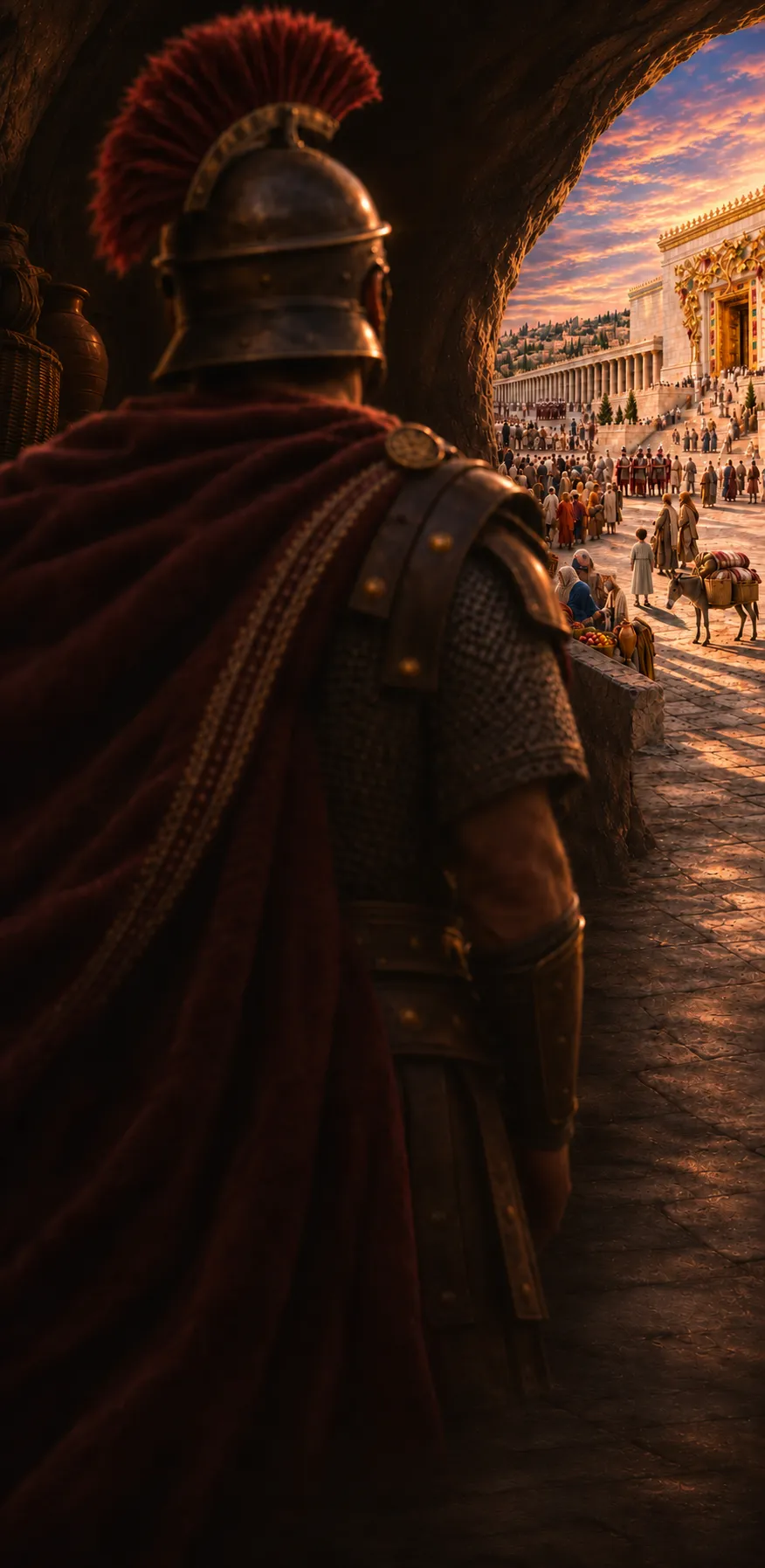
The Sign
“What will be the sign of your coming and of the end of the world?” Luke 21:7
The disciples had been pointing out to Jesus the fabled beauty and sheer engineering genius of the temple’s construction. Their bubbles burst when he told them their magnificent icon, their nation’s pride and joy, would become a pile of rubble—in their generation.
They were stunned.
Some of them had dropped their fishing tackle on the beach and literally walked away from their livelihoods, sleeping rough and living lean for three and a half years following this charismatic and controversial Messiah they believed had finally arrived. They fully expected he would restore the kingdom to Israel. They fancied themselves holding highest office in a mighty global empire. And now he was talking about the total destruction of the nation’s beating heart. To their ears it could only mean one thing: the end of the world. What, then, were they to look out for? Perplexed, they wanted a definite signal.
Overlooking the temple scene that evening four of them ventured to ask him privately when this shocking revelation would happen. They needed clarity. Really needed it.
The first thing Jesus told them was to be very careful whom they believed.
When you see it
Jesus spoke of wars, famines, pandemics and earthquakes. All those things would tell them the world was in trouble alright. But they hardly needed a prophet for that. What they needed was something specific they could recognise in time to act.
Then Jesus focussed a laser beam on Daniel’s final message.
“When you see the ‘abomination of desolation’ ead Daniel 12:11 which Daniel the prophet spoke about, standing in the holy place (anybody who later reads this account should be sure to understand what I’ve just said), that will be your signal to act without delay.” Luke records the same warning in even more explicit terms. When they saw Jerusalem surrounded by armies, they were to know that its devastation was near. Those in Judea were to flee to the mountains.
There’s a very practical word in all this. When.
Jesus was telling people what to do when they saw something. By the time Jerusalem lay in ruins, the signal to flee would be useless.
The army that evaporated
In the autumn of AD 66, the Roman general Cestius Gallus marched on Jerusalem. His troops got close enough to the temple to start undermining a wall and prepare to set fire to one of its gates. The Jewish historian, Josephus, survived the siege and says the defenders were losing heart. Some inside the city had actually reached the pitch where they were ready to let the Romans in.
Then Cestius simply withdrew. Like a morning mist the Romans were gone.
Josephus, who usually has something to say about everybody’s motives, could find no good reason for it. Whatever Cestius’s motives were, the abrupt retreat gave people a chance to get out. Eusebius reports the believers took refuge in the little fortified town of Pella, some distance away across the Jordan. Not one of them perished. “The wise”.
About three and a half years (1260 days) after Cestius’s aborted campaign, in the spring of AD 70, Titus, another Roman general, laid siege to Jerusalem. His legions also assembled in the place outside the walls the Jews called “Holy”View Jerusalem AD 66 Famine took brutal hold. And in one of history’s most horific holocausts, the people became so desperate, in abandonment of all natural instinct, mothers ate their own babies to survive. Men gnawed on the leather of their shoes.
The Romans breached the walls and a soldier threw a firebrand into the cedar-lined temple porch. Quickly engulfed in flames, the gold that was everywhere inside the temple melted. It ran down the walls and into the cavities between the stones. In the frenzy soldiers overturned them to seize the booty, enough for the good life back in Rome.
For people still inside the city, the chance to get away had passed. They had refused to believe the loud cry the disciples raised for three and a half years because their comfortable tradition reassured them everything was just fine. “The foolish”.
The retreat in AD 66 must have looked like good news to almost everyone. To those who remembered Jesus’ words, it was news of a different kind. Here was the signal to leave that Jesus had given them. Not in a last-minute frantic scramble. A well-prepared, provisioned and orderly move. In AD 70—three and a half years later—it would be a very different story.
Why Jesus drew a bead on Daniel
Jerusalem’s tragedy gives us an accurate way to understand the warning as it applies to us. It also shows why Jesus was so particular about people recognising it for themselves, not just drifting on a familiar cultural tradition.
Ironically, because they fail to understand the warning, the watchmen’s own city can still be bustling, its temple thriving and the people going about life as usual—at the very moment they should be high-tailing it to Pella—well prepared. Oil supply: full.
And that’s the awful picture Jesus paints.
But the disciples had also asked about his physical return to Earth. As Jesus’ answer unfolds, he speaks of a coming deception so convincing it will mislead the majority of lifelong church-goers who fail to recognise and act on the signal. Only a few among them have been watching, taking heed—too busy planning as though Jesus wouldn’t come for another 100 years. Then immediately afterward Jesus confirms the “coming of the Son of Man” and the indescribable anguish of the distracted and preoccupied. That is why the book 1335 Days carefully re-examines Daniel’s final warning with fresh eyes. What’s at stake in reality couldn’t be greater.
The book reads Jerusalem as a precedent for the warning Jesus gave to people living close to the end, and finds the actual timing of that warning lying in plain sight where it has been all along. Obscured by an honest-hearted, but nonetheless man-made, mistaken tradition.
Daniel gives us three numbers. The first is expressed as three and a half “times”. The other two are given in “days”. How do they fit together? And what does Daniel say happens when the count begins?
Next → THE THREE NUMBERS